Property Architectures in Search Console
When setting up Google Search Console, you are faced with a fundamental structural choice: Domain Property or URL-Prefix Property. Choosing the wrong model can blind your engineering and SEO teams to critical indexing failures, subfolder trends, or protocol migrations.
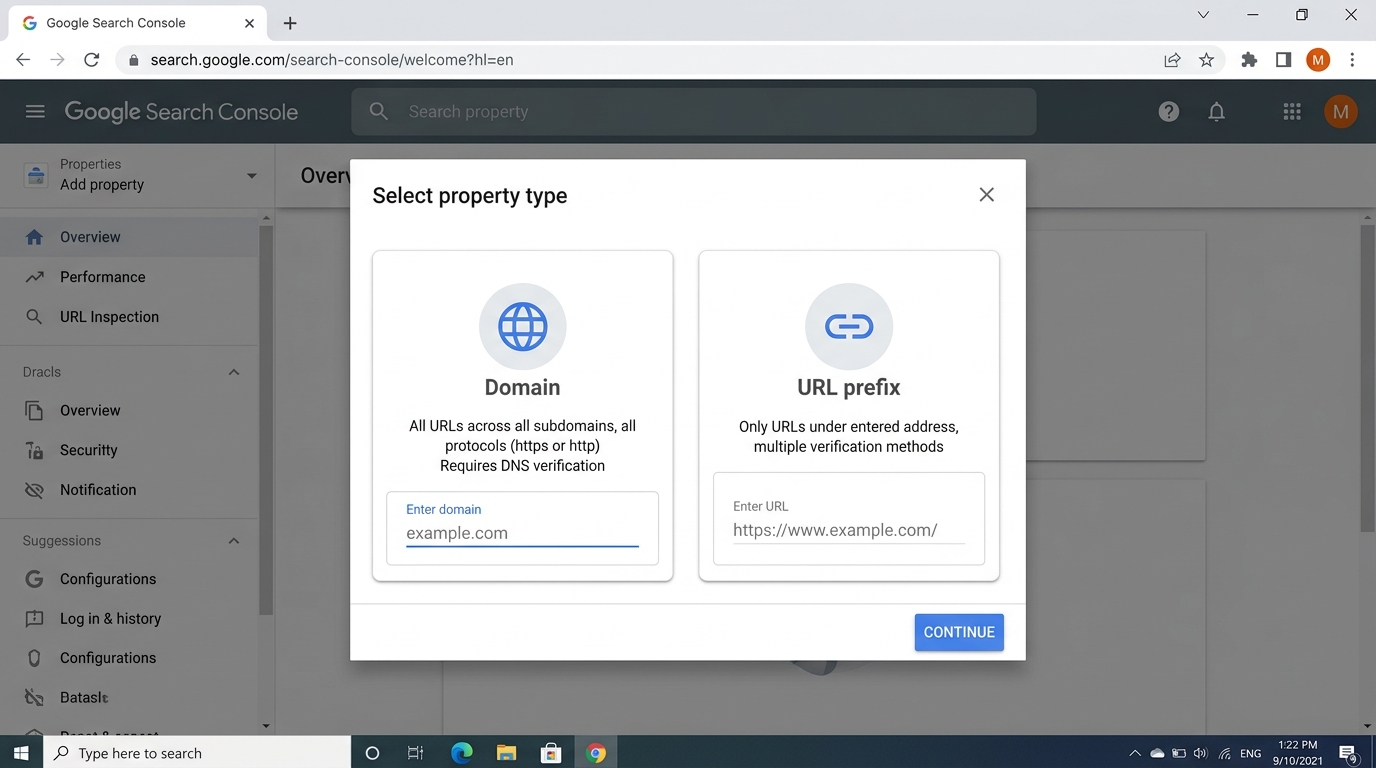 Figure 0.1: The initial GSC property creation modal comparing Domain properties (aggregate DNS coverage across all subdomains) and URL-prefix properties (protocol and path-specific).
Architectural Comparison
┌────────────────────────────────────────────────────────────────────────┐
│                        DOMAIN PROPERTY: example.com                    │
│                                                                        │
│  ├── https://example.com/           ├── http://example.com/            │
│  ├── https://www.example.com/       ├── http://www.example.com/        │
│  ├── https://blog.example.com/      ├── https://shop.example.com/      │
│  └── https://staging.example.com/   └── https://app.example.com/       │
└────────────────────────────────────────────────────────────────────────┘
┌────────────────────────────────────────────────────────────────────────┐
│ URL-PREFIX PROPERTY: https://www.example.com/ │
│ │
│ └── STRICT MATCH: Only URLs matching https://www.example.com/* │
│ (Excludes http://, root domain example.com, and subdomains) │
└────────────────────────────────────────────────────────────────────────┘Matrix: Feature & Coverage Breakdown
| Feature | Domain Property (example.com) | URL-Prefix (https://www.example.com/) |
|---|---|---|
| Verification Method | Strictly DNS TXT Record | HTML file, meta tag, GTM, GA4, DNS |
| Protocol Coverage | Both http:// and https:// | Specific protocol only |
| Subdomain Coverage | All existing and future subdomains | Exact host match only |
| Path / Subfolder Scope | Full domain only | Can be scoped to subfolders (/blog/, /uk/) |
| International Targeting | Global | Can isolate regional language branches |
| Disavow Tool Support | Supported | Supported |
| Change of Address Tool | Supported | Supported |
The Root Cause: Google was still indexing legacy http:// URLs because several redirect chains were returning 302 Temporary Redirects instead of permanent 301s. Because they lacked a Domain Property, the traffic and impressions occurring on the HTTP protocol were completely invisible to their team.
The Hybrid Property Portfolio Strategy
For high-traffic enterprise architectures, international websites, or multi-team organizations, the industry standard is to deploy a Hybrid Property Architecture:
- Top-Level Domain Property (
example.com): Serves as the executive overview and organization-wide truth source. - Subfolder URL-Prefix Properties (
https://example.com/fr/,https://example.com/de/,https://example.com/blog/):- Grants segmented access to dedicated localization or content teams without exposing core transaction data.
- Allows fine-grained monitoring of index coverage and crawl efficiency per content silo.